Welcome to our websites!
nybjtp

2026 Top Wolver Generator Set Types for Global Buyers

The 2026 market for generator sets will be shaped by rising electricity demand, stricter emissions expectations, and more complex operating conditions. The International Energy Agency’s Electricity 2024 report forecasts global electricity demand growth of about 4% annually through 2026. It also expects data-centre consumption to increase sharply, approaching 1,000 terawatt-hours by 2026. These trends are increasing demand for dependable backup and prime-power systems.

Wolver Generator Set solutions deserve attention because global buyers need more than rated output. They need stable voltage, efficient fuel use, service access, and reliable performance in heat, dust, humidity, or high altitude. A 500 kVA unit may appear suitable on paper, yet its real performance can change with load profile, ambient temperature, and maintenance quality. Small details matter.

The 2026 Top Wolver Generator Set Types for Global Buyers should therefore compare diesel, gas, silent, mobile, containerized, and hybrid configurations. Each type serves a different operating purpose. Diesel sets often support heavy-duty applications and remote sites. Gas models can suit locations with dependable fuel infrastructure. Hybrid systems may reduce fuel consumption during fluctuating loads.

Industry reports provide useful direction, but they cannot replace site-specific evaluation. Market forecasts sometimes use different definitions and data periods. That limitation deserves attention. Buyers should verify fuel standards, alternator quality, control systems, warranty coverage, and local technical support before purchasing. The strongest choice is not always the largest set. It is the one that delivers dependable power with measurable operating value.
2026 Top Wolver Generator Set Types for Global Buyers

Wolver Generator Set Basics and Core Classification

2026 Top Wolver Generator Set Types for Global Buyers

Wolver generator set basics begin with duty classification. Standby sets support outages and usually run for limited hours. Prime-power sets operate at variable loads for extended periods. Continuous-power sets serve stable loads without planned utility support.

ISO 8528-1 separates these ratings, but buyers often compare them incorrectly. A 500 kVA standby rating is not automatically a 500 kVA prime rating. Check the rating plate and load profile.

Fuel and mobility create another practical classification.

Diesel units suit remote sites, heavy construction, and emergency backup. Gas units can reduce local emissions when a reliable pipeline exists. Mobile sets use trailers or compact frames, while stationary sets support hospitals, factories, and data facilities.

The International Energy Agency’s Electricity 2024 report estimates data-centre electricity demand could exceed 945 TWh by 2030. That growth increases demand for synchronized standby systems, yet cooling and fuel logistics remain easy to underestimate.

Hybrid systems add batteries, solar input, and intelligent controls.

They can reduce low-load running, where engines waste fuel and suffer carbon buildup. The Global Off-Grid Solar Market Report 2024 shows diesel displacement remains a major hybrid-power driver in remote applications.

Still, battery autonomy may be short during prolonged outages. I have seen specifications look strong on paper, then fail under motor-starting loads. Buyers should verify transient response, harmonics, altitude derating, enclosure protection, and service access before selecting a set.

Main Wolver Generator Set Types by Fuel and Engine Design

2026 Top Wolver Generator Set Types for Global Buyers

Main Wolver Generator Set Types by Fuel and Engine Design

Wolver generator sets are commonly selected by fuel availability, operating hours, and site conditions. Diesel models remain practical for construction sites, hospitals, and remote facilities. They deliver strong torque and stable output under heavy loads. Gas generator sets produce lower local emissions and suit factories with reliable pipeline access. Dual-fuel designs offer flexibility when fuel prices or supply conditions change. However, conversion efficiency can vary between sites.

Engine design also affects service life and daily performance. Air-cooled engines are compact and easier to maintain for smaller power ranges. Liquid-cooled engines handle long shifts and high ambient temperatures more effectively. Inline engines usually simplify maintenance, while V-shaped engines can provide higher power in a shorter frame. Electronic fuel injection improves load response and fuel control. Mechanical systems may remain useful where diagnostic tools and trained technicians are limited.

Variable-speed generator sets can reduce fuel use during partial loads. Fixed-speed designs often provide predictable frequency for continuous industrial equipment. Open-frame sets support easy inspection, but enclosed models reduce noise and protect components from dust. Check ambient temperature, altitude, load profile, and spare-parts access before choosing. I have seen buyers focus too heavily on rated power. That can be a costly mistake. Real projects often need better starting capacity, stronger cooling, or a larger fuel tank. Specification sheets help, but field measurements should decide the final configuration.

2026 Top Wolver Generator Set Types for Global Buyers - Main Wolver Generator Set Types by Fuel and Engine Design
Generator Set Type Primary Fuel Engine Design Typical Electrical Output Typical Speed Main Applications Key Advantages Important Buying Considerations
Diesel Generator Set Diesel Four-stroke, compression-ignition engine; turbocharged and intercooled in many medium- and high-output models Approximately 5 kVA to 3,000+ kVA per set 1,500 or 3,000 rpm at 50 Hz; 1,800 or 3,600 rpm at 60 Hz Construction sites, factories, commercial buildings, telecom sites, hospitals and standby power High energy density, reliable load response, broad power range and mature service infrastructure Fuel quality, emissions regulations, noise control, maintenance access and required runtime
Natural Gas Generator Set Pipeline natural gas or compressed natural gas Four-stroke, spark-ignition gas engine with air-fuel control and an exhaust catalyst where required Approximately 20 kWe to several MWe per set Commonly 1,500 or 1,800 rpm for medium-speed units; higher speeds are also available Commercial facilities, distributed generation, utilities, data centers and combined heat and power Lower particulate emissions than diesel, clean combustion and potential for CHP efficiency Gas pressure and continuity, pipeline availability, methane emissions, installation ventilation and local codes
Biogas Generator Set Biogas from anaerobic digestion, wastewater treatment or landfill gas Spark-ignition gas engine or modified dual-fuel engine; gas cleaning is normally required Approximately 30 kWe to 2 MWe per set Usually 1,500 or 1,800 rpm for larger stationary units Farms, food-processing plants, wastewater facilities, landfills and municipal energy projects Uses locally produced renewable gas and can reduce waste-management costs Methane concentration, hydrogen sulfide removal, moisture control, siloxanes, gas storage and engine oil condition
Dual-Fuel Generator Set Natural gas or biogas combined with a small diesel pilot supply Compression-ignition engine operating with gas substitution and diesel pilot ignition Approximately 100 kVA to several MVA per set Commonly 1,500 or 1,800 rpm for industrial stationary systems Remote industrial sites, microgrids, oil and gas facilities, mines and locations with uncertain gas supply Fuel flexibility, reduced diesel consumption and the ability to continue operating when gas supply changes Gas substitution rate, control-system compatibility, pilot-fuel consumption and transient-load performance
Gasoline Generator Set Gasoline Small four-stroke, spark-ignition engine; portable models may use recoil or electric starting Approximately 0.5 kVA to 20 kVA for common portable units Often 3,000 to 3,600 rpm; inverter models vary engine speed with load Household emergency power, small tools, outdoor events, recreational use and light commercial work Compact size, simple starting and easy short-term deployment Higher fuel volatility, limited continuous-duty suitability, safe storage and carbon-monoxide ventilation
Inverter Generator Set Usually gasoline; some models use diesel or liquefied petroleum gas Engine-driven alternator connected to a rectifier and electronic inverter; variable-speed operation is common Approximately 0.8 kVA to 10 kVA for common portable models Variable engine speed, with output electronically regulated to the selected frequency Sensitive electronics, mobile work, camping, residential backup and low-noise applications Stable voltage and frequency, lower noise and improved part-load fuel economy Electronic-repair capability, battery condition, maximum surge capacity, parallel operation and cooling airflow
Heavy-Fuel-Oil Generator Set Heavy fuel oil or residual fuel oil Large-bore, low-speed two-stroke or medium-speed compression-ignition engine with fuel heating and treatment systems Typically 1 MWe to tens of MWe per generating unit Low-speed systems may operate below 500 rpm; medium-speed systems commonly operate around 500–1,000 rpm Large industrial plants, isolated grids, marine power and utility-scale generation Suitable for large continuous-duty output and can use lower-cost heavy fuel where permitted Fuel heating, filtration, ash and sulfur content, emissions controls, storage systems and extensive maintenance infrastructure
Marine Diesel Generator Set Marine diesel oil, diesel or other approved marine fuels Marine-rated four-stroke compression-ignition engine with corrosion protection and seawater cooling arrangements Approximately 20 kWe to several MWe per set Commonly 720 to 1,800 rpm, depending on vessel size and electrical frequency Cargo vessels, offshore platforms, ferries, fishing vessels and workboats Designed for vibration, tilt, saltwater exposure and continuous onboard operation Classification requirements, seawater cooling, exhaust routing, fuel compatibility, redundancy and onboard service access
Technical note: Output ratings and engine speeds are representative industry ranges rather than limits for every model. Actual specifications depend on frequency, duty rating, site altitude, ambient temperature, emissions regulations, fuel quality and manufacturer configuration.

Wolver Generator Set Options by Power Output and Application

Generator set selection in 2026 depends on power output, operating conditions, and the application’s risk profile. Small sets below 100 kVA suit retail stores, clinics, and temporary offices. They fit narrow service areas and consume less fuel during light loads. Quiet operation matters in populated locations.

Medium units from 100 to 500 kVA support workshops, farms, telecom sites, and apartment buildings. These systems often need automatic transfer equipment, weather protection, and remote monitoring. Large sets above 500 kVA serve factories, hospitals, data facilities, and construction compounds. Parallel operation can improve capacity and maintenance flexibility. It also adds control complexity.

Application details should guide the final specification. Motors, pumps, compressors, and elevators create starting surges that basic running-load estimates may miss. I have seen projects undersized after ignoring cold weather, altitude, and future expansion. That mistake becomes expensive. A practical assessment records essential loads, starting currents, fuel access, noise limits, and service routes. Load-bank testing after installation can reveal unstable voltage or poor cooling before an outage occurs. However, testing alone cannot predict every field condition. Engineers should review seasonal demand and maintenance records regularly. The “ideal” set may change as equipment, regulations, or operating schedules change.

Key Features, Standards, and Global Buyer Requirements

The 2026 generator set market will favor solutions matched to real operating conditions. Diesel sets remain practical for construction, hospitals, factories, and remote sites. Gas and hybrid systems can reduce fuel use where infrastructure allows. Buyers should check prime power, standby rating, load profile, and expected running hours. A 500 kVA set may not suit a site with frequent low-load operation. Wet-stacking risks are often underestimated.

International buyers should request documented testing, clear wiring diagrams, and service records. ISO 8528 performance ratings help compare generator sets consistently. ISO 9001 certification can indicate controlled manufacturing processes, but it does not replace product inspection. Emission requirements differ between regions, ports, and project sites. Noise limits, voltage frequency, enclosure protection, and fuel-tank rules also need confirmation. Local electricians should verify phase balance and automatic transfer compatibility. Specifications can look complete and still hide gaps.

Tips: Ask for a factory test report. Confirm spare-part availability before purchase. Check cold-start performance in winter regions. Request corrosion protection for coastal projects. Keep at least ten percent capacity for future loads, but avoid excessive oversizing. It wastes fuel. A practical buyer should compare total operating cost, not only the quoted price. I have seen projects choose larger sets for comfort, then face poor efficiency and higher maintenance. Rechecking the load survey is worth the extra day.

How to Select the Right Wolver Generator Set in 2026

2026 Top Wolver Generator Set Types for Global Buyers

How to Select the Right Wolver Generator Set in 2026

Selecting the right Wolver generator set starts with the actual load, not the nameplate rating. Record motors, heaters, pumps, and sensitive electronics separately. A hospital backup system may need high standby power, while a remote workshop may require prime power for daily operation. Leave practical headroom, usually 15% to 25%, for starting surges and future equipment.

Fuel choice depends on operating hours, storage conditions, and local supply. Diesel sets often suit demanding industrial use, while gas models can reduce emissions where a stable gas network exists. In cold regions, check battery heating, coolant protection, and fuel performance. In dusty areas, inspect air filtration and enclosure sealing. Small details matter.

Sound levels matter near homes, offices, and construction sites. Select an enclosure, exhaust system, and automatic transfer switch that match the installation. Confirm voltage, frequency, phase, and emissions requirements before purchasing. Ask for test records, maintenance intervals, spare-part access, and technician support. A low purchase price can hide expensive downtime. It happens.

Do not size a set only for the largest connected load. Measure real demand during normal operation and test critical starting loads. A spreadsheet may look precise, yet field conditions can disagree. Review the design with a qualified engineer, especially for parallel operation or essential services. Reliable selection is careful, documented, and slightly cautious.

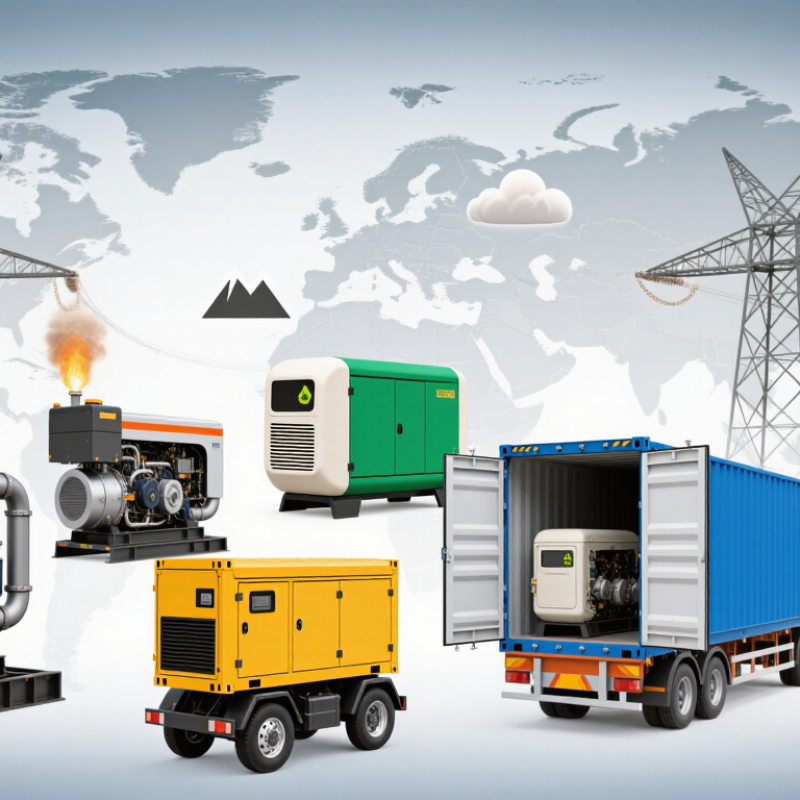
The chart compares representative output ranges for major generator set types commonly considered by global buyers in 2026. Actual capacity depends on the engine, alternator, operating mode, local regulations, and site load profile. Select the set by required kVA, duty cycle, fuel availability, noise limits, emissions requirements, and service conditions.